Archive for truepath

Is International Law Genuine ‘Law’?

(C) Kapok Tree Diplomacy. 2011. All rights reserved. Jeff Dwiggins. FREE CONTENT

In answering this question, I must first appeal to the American Law Institute’s “Restatement of the Law, Third, Foreign Relations Law of the United States.” In Section 101 it defines international law as follows: “international law consists of rules and principles of general application dealing with the conduct of states and of international organizations and with their relations inter se, as well as with some of their relations with persons, whether natural or juridical.”

Section 102 of this document refers to the sources as “customary law,” “international agreement,” and “derivation from general principles common to the major legal systems of the world.” Section 103 refers to the evidence of international law being “judgments and opinions of international judicial and arbitral tribunals;” “judgments and opinions of national judicial tribunals;” “the writings of scholars;” and “pronouncements by states that undertake to state a rule of international law, when such pronouncements are not seriously challenged by other states.”

Thus, to answer the question of whether international law is law, one must look at its rules and principles inherent in its definition, its sources, and its evidence to make a determination as to its strength, validity, coherence and legitimacy. I would submit that the whole point of law is to bring about justice as a vehicle for truth and liberty. Does international law result in justice? Do its sources and evidences comport with truth and equality? Read more
Do NGOs have a Place in Conflict Resolution? Are They Really Neutral? Are Military PRTs the Answer?

(C) Kapok Tree Diplomacy. 2010. All rights reserved. Jeff Dwiggins. FREE CONTENT

NGOs are essential to conflict resolution in as much as they possess the necessary skills, knowledge, personnel and experience to help resolve the conflict and the context is favorable to their participation. Certainly, the traditional role of the NGO has changed in nature from one of purely humanitarian relief to one that includes the roles of civil society builder and peace broker. This role transformation challenges the NGO’s assertion of neutrality and inviolability. Pamela Aall lists certain conditions that must exist prior to NGO conflict resolution intervention, saying NGOs must have:

·   Knowledge of the country and the regional institutions involved (14)

·   Indigenous partners (14)

·   Good knowledge of conflict mediation skills (14)

·   Inherent understanding of the personal risks involved (14)

David Baharvar explains, “The basic mission of the major NGOs devoted to international ethnic conflict resolution is to transform the way that torn societies deal with a conflict and to improve the process of conciliation. Their efforts typically are focused on capacity-building: consultation, dialogue, and training in conflict resolution for people on all sides of an ethnic conflict” (2001).

The posts, views and opinions expressed on this site are completely my own and do not represent the views or opinions of the Department of Defense (DoD), the Department of the Navy (DON) or any of the Armed Forces.  Read more

Using Economic and Military Tools in Conflict Prevention

(C) Kapok Tree Diplomacy. 2010. All rights reserved. Jeff Dwiggins. FREE CONTENT

There’s a number of economic tools that may be effective in preventing conflict. Most seem to fall under good governance. The first one that comes to my mind is export diversity. If you depend on one item for 44% of your exports and that one item is a commodity as it is with Sierra Leone’s diamonds, your economy is extremely vulnerable to global price fluctuations in that commodity. A downward dip in prices can have a devastating effect when all your eggs are in one basket. If people have to be laid off or you have to cut their wages, then social dissent can escalate as a result.

The second item that comes to mind is avoiding growth without development. If a nation choose to ignore its infrastructure and social services at the expense of corruption and out-of-control government spending, or spending on things that do not have a long-term impact like million dollar conferences, then that nation will suffer the consequences in decreased foreign direct investment and increased social dissent.

The third economic tool I can think of is well-developed economic and market institutions that are capable of opening up the economy to increased trade.  Peter Sutherland adds that increased trade may “challenge domestic corruption, encourage competition, release entrepreneurialism, ensure affordable services, “provide cover for reformers”, increase foreign investment (examples: Saudi Arabia, Cambodia, China), and increase personal civil rights and freedoms by virtue of access to greater levels of information via the internet, cell phones, etc.” (2008).

The posts, views and opinions expressed on this site are completely my own and do not represent the views or opinions of the Department of Defense (DoD), the Department of the Navy (DON) or any of the Armed Forces. Read more

Are Confidence Building Measures Effective in the Middle East?

(C) Kapok Tree Diplomacy. 2010. All rights reserved. Jeff Dwiggins. FREE CONTENT

Diehl lays out five dimensions of peace building which are applicable to the situation in the sense that CBM’s can be a significant component of peace building activities.  Diehl’s dimensions are (1) the goal; (2) the strategy and activities; (3) the timing; (4) the context; and (5) the actors who will bring it about (8-11).

Applying Diehl’s “broader context” we could also say that conflict resolution – the elimination of the “willingness of parties to use violence” (9) – is a fundamental goal to achieving a lasting, sustainable peace. The StimsonCenter specifies communication, constraint, transparency and verification measures as primary CBM tools that could conceivably be used within these five dimensons of peacebuilding (2010). Which ones would be feasible or effective? It depends on the peace building dimensions.

The context, goal and actors primarily drive the strategy. The timing is important but secondary given the length of this particular conflict. The context of Israel/Palestine situation differs significantly from the US/Russia Cold War example, while being more similar to the India/Pakistan example in some respects.

The posts, views and opinions expressed on this site are completely my own and do not represent the views or opinions of the Department of Defense (DoD), the Department of the Navy (DON) or any of the Armed Forces. Read more

Zero Problems – Enhancing Security and Preventing Conflict in Turkey’s Evolving Partnerships with the European Union, United States, Middle East, Russia and Eurasia

“Zero Problems – Enhancing Security and Preventing Conflict in Turkey’s Evolving Partnerships with the European Union, United States, Middle East, Russia and Eurasia” by Kapok Tree Diplomacy

FREE PREVIEW

Zero Problems – Turkey – FREE PREVIEW

Zero Problems – Enhancing Security and Preventing Conflict in Turkey’s Evolving Partnerships with the European Union, United States, Middle East, Russia and Eurasia

{5,673 Words. 20 Pages. 61 References} 

FREE PREVIEW

TABLE OF CONTENTS (TOC)

I.     Section One – Europe and the Balkans

A.    European Union (EU) Accession

B.     Cooperation with NATO

C.     Cyprus and Greece Conflict

II.     Section Two – The Middle East            

A.    Israel

B.     Iran

C.     Syria

D.    Iraq

E.     Foreign Policy Perspective

III.   Section Three – Eurasia and the Caucasus

A.    Russia

B.     Armenia and Azerbaijan

IV.    Turkish Cooperation with the United States

V.      Turkey’s Domestic Issues

A.    The Kurdish Problem

B.     Political Trends, Islam and Social Transformation

C.     Comparisons with China

VI.    Conclusions: Conflict Prevention Through Strategic Counterbalancing

The views and opinions expressed in this paper are completely my own and do not represent the views or opinions of the Department of Defense (DoD), the Department of the Navy (DON) or any of the Armed Forces.

Section One – Europe and the Balkans (*not the complete section*)

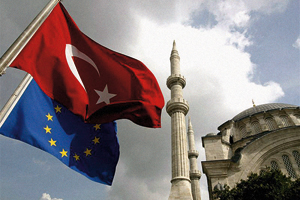
European Union (EU) Accession. Ahmet Davutoğlu, Turkey’s Minister of Foreign Affairs, says that EU Accession is on an “irreversible course” that will produce enhanced peace, stability, indivisibility of security, economic interdependence, cultural harmony and convergent interests in a region that includes the Balkans, the Caucasus, Europe and the Middle East (Davutoğlu:EU 12-17). The interests of the EU and Turkey do not, however, always converge harmoniously, and accession progress has slowed considerably since Brussels opened membership talks in 2005 with major regional security implications (Alessandri 28-29). Read more

Civil War and Crisis in Côte d’Ivoire – An Analysis of the Steps Taken by the International Community to Prevent, Manage and Resolve the Conflict

“Civil War and Crisis in Côte d’Ivoire – An Analysis of the Steps Taken by the International Community to Prevent, Manage and Resolve the Conflict ” by Kapok Tree Diplomacy

%d bloggers like this: